
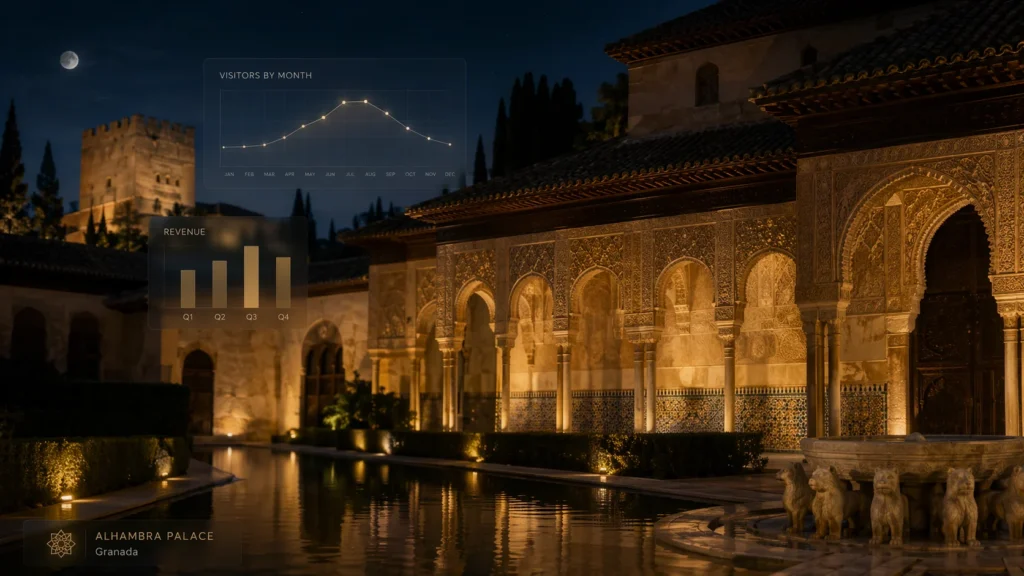
The Alhambra Palace night tour attendance revenue is one of those topics that sounds simple but quickly gets complicated once you look at the real data. On the surface, it’s just tickets sold at night in Granada. But in reality, it reflects strict visitor control, limited access, and a revenue model built more on preservation than volume.
If you’re expecting massive crowds and blockbuster earnings, the truth is more nuanced. And that’s exactly where it gets interesting.
What the Alhambra night tours actually are (and why they matter)
The night experience at the Alhambra is not a full-site visit. It usually focuses on two main experiences:
- Nasrid Palaces night visit
- Generalife and gardens night visit
These tours are designed to be quieter, shorter, and more controlled than daytime entry. That control is the key reason the Alhambra Palace night tour attendance revenue behaves very differently from normal tourism income.
Unlike daytime visits, night access is intentionally limited to protect fragile architecture and manage crowd pressure.
Night tour attendance: small numbers, strict limits
Here’s where expectations often clash with reality.
Night tours typically attract only about 120,000 to 150,000 visitors per year based on recent estimates.
To put that into perspective:
- The full Alhambra complex gets around 2.5 to 3 million visitors annually
- Night tours represent roughly 5% or less of total attendance
- Daily night capacity is often just a few hundred people
That’s not a tourism flood. It’s controlled flow by design.
So when people talk about Alhambra Palace night tour attendance revenue, they’re really talking about a small but highly managed segment of total tourism.
Ticket pricing: low cost, steady income
Another surprising detail is pricing.
Night tickets are usually affordable:
- Around €8–€13 for standard night entry
- Higher prices for guided or premium experiences
Even though the price per ticket is low, the system is stable because:
- Tours run regularly throughout the year
- Demand is consistent due to global tourism interest
- Booking limits create near-guaranteed sell-through on many dates
This is where the Alhambra Palace night tour attendance revenue starts to look less like luxury tourism and more like controlled public access with monetization built in.
Estimated revenue: why the numbers don’t agree
Different analyses give different results, and that’s where confusion starts.
Here’s a realistic range based on available estimates:
- Lower estimates: €1–2 million annually from night tours
- Higher estimates: up to €8–12 million annually including guided add-ons and upsells
Why such a gap?
Because revenue depends on what you include:
- Basic ticket sales only
- Or ticket sales + guided tours + audio guides + bundled experiences
This is important: the Alhambra Palace night tour attendance revenue is not officially broken out in detail in public financial reports, so analysts reconstruct it from partial data.
Why attendance is capped (and why that actually increases value)
Here’s a counterintuitive idea: the Alhambra doesn’t try to maximize attendance.
Instead, it caps it.
Why?
- The Nasrid Palaces are extremely fragile
- Overcrowding risks long-term damage
- UNESCO preservation rules limit visitor pressure
So instead of scaling volume, the site scales value per visitor.
That changes everything about the Alhambra Palace night tour attendance revenue model:
- Less crowding
- Higher experience quality
- More predictable income per visitor
In simple terms: fewer people, better yield.
Night vs day revenue: not even the same game
A common assumption is that night tours are just “extra income.”
That’s not really accurate.
Daytime visits dominate total revenue because they carry:
- Much higher total visitor volume
- Longer visiting duration
- More structured ticket allocation
Night tours, on the other hand:
- Act like a premium extension of demand
- Fill limited off-peak capacity
- Strengthen overall tourism value for Granada
So the Alhambra Palace night tour attendance revenue is more like a supporting pillar than the main structure.
Economic impact beyond ticket sales
The real financial influence of night tours goes beyond entrance fees.
Night tourism affects:
- Local hotels (late check-ins, extended stays)
- Restaurants (post-visit dining demand)
- Transport services (taxis, guided transfers)
- Granada’s off-peak tourism economy
This indirect spending often exceeds the ticket revenue itself.
So even if night tour income looks modest on paper, its ripple effect is much larger.
The capacity paradox: why demand stays high
One of the most interesting parts of the system is this:
Even with limited slots, demand rarely drops.
Why?
- The Alhambra is a global bucket-list destination
- Night access feels exclusive
- Tickets often sell out weeks in advance
- Social media increases “scarcity appeal”
This creates a loop:
Limited supply → high demand → stable pricing → consistent Alhambra Palace night tour attendance revenue
Final takeaway: what the numbers really say
If you strip everything down, the conclusion is simple but important:
The Alhambra Palace night tour attendance revenue is not about scale. It’s about controlled exclusivity.
It works because:
- Attendance is intentionally limited
- Pricing stays accessible but steady
- Experience value is prioritized over volume
- Revenue is stable, not explosive
And that’s exactly why it continues to function as a sustainable cultural tourism model rather than a mass tourism product.
FAQ
How much is the Alhambra Palace night tour attendance revenue per year?
The Alhambra Palace night tour attendance revenue is generally estimated to range between €1 million and €12 million annually, depending on what is included in calculations. If you only count ticket sales, the figure is on the lower end. If you include guided tours and bundled experiences, it rises significantly. The key point is that this revenue stream is small compared to daytime visits but still financially stable.
Why is the Alhambra Palace night tour attendance revenue relatively low?
The main reason the Alhambra Palace night tour attendance revenue stays limited is intentional capacity control. Night tours are designed for preservation, not mass tourism. Visitor numbers are restricted to protect fragile structures like the Nasrid Palaces. So even if demand is high, the site does not increase supply, which naturally caps total revenue.
How many people attend Alhambra night tours each year?
Annual attendance for night tours is typically estimated between 120,000 and 150,000 visitors. This is a small fraction of total Alhambra traffic. Because of this controlled flow, the Alhambra Palace night tour attendance revenue remains steady but never reaches the scale of daytime ticket income.
What makes night tours different from daytime visits financially?
Night tours operate on a completely different model. While daytime visits focus on high volume, night tours focus on exclusivity and experience quality. This means the Alhambra Palace night tour attendance revenue comes from fewer tickets but slightly higher perceived value per visit. However, it still does not surpass daytime revenue due to strict visitor caps.
Are Alhambra night tour tickets expensive?
Not really. Standard night tickets usually cost between €8 and €13, depending on the area visited and whether a guided experience is included. Even with low pricing, the Alhambra Palace night tour attendance revenue remains consistent because demand is strong and booking slots are often fully reserved in advance.
Does the Alhambra earn more from night tours or day tours?
Day tours generate significantly more revenue because they handle millions of visitors annually. Night tours contribute a smaller but stable portion. So when comparing both, the Alhambra Palace night tour attendance revenue is supportive rather than dominant. It adds value, but it is not the main financial driver of the monument.
Why do night tours sell out so quickly if revenue is limited?
This is where demand dynamics matter more than revenue size. The Alhambra Palace night tour attendance revenue is limited because capacity is limited, not because interest is low. Night tours are considered exclusive and atmospheric, which increases demand even when supply is tightly controlled.
Does the Alhambra Palace night tour attendance revenue include guided tours?
In many estimates, yes. Broader calculations of Alhambra Palace night tour attendance revenue often include guided tours, audio guides, and premium packages. These add-ons increase per-visitor earnings slightly, but they still operate within the same restricted attendance system.
Is the night tour financially important for the Alhambra?
Yes, but not in the way people expect. The Alhambra Palace night tour attendance revenue is not about maximizing profit. It plays a strategic role in spreading visitor flow, improving tourist experience, and supporting Granada’s night-time economy. Its value is more structural than purely financial.