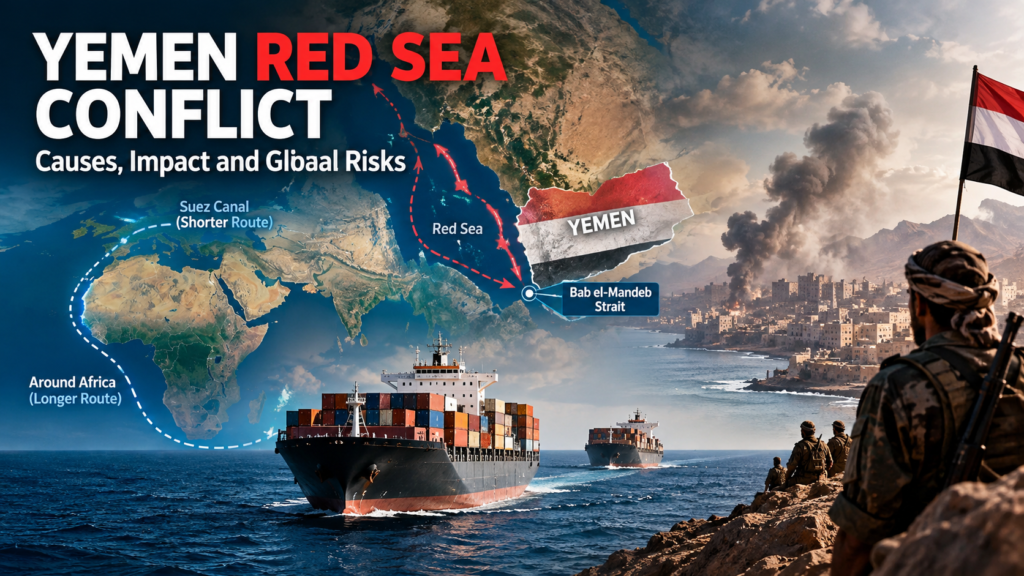
A cargo ship moving between Asia and Europe has a choice to make: pass through the Red Sea, as generations of vessels have done, or take the much longer route around Africa.
On a map, the decision may look simple. At sea, it can mean thousands of additional miles, higher fuel costs, delayed deliveries and greater insurance expenses. Behind that decision lies a much larger story—a conflict in Yemen that has turned one of the world’s most important waterways into a center of international tension.
The Yemen Red Sea conflict is no longer only a Yemeni story. It has become a global concern involving maritime trade, regional rivalries, military power and the future of one of the world’s busiest shipping corridors.
But while governments focus on ships, missiles and strategic waterways, Yemen’s civilians continue to live with the consequences of a conflict that has already lasted for years.
A Conflict That Began Far From the Shipping Lanes
Yemen’s crisis did not begin with attacks on ships in the Red Sea.
The country’s modern conflict grew out of years of political instability, economic hardship and rivalry between competing political and military forces. The Houthi movement, also known as Ansar Allah, emerged as one of the country’s most powerful forces and seized control of the capital, Sanaa, in 2014.
The following year, Saudi Arabia and its allies intervened militarily in support of Yemen’s internationally recognized government.
What followed was a devastating war involving Yemeni factions and regional powers. Cities and infrastructure were damaged, millions of people were affected and Yemen developed one of the world’s most serious humanitarian crises.
The Red Sea became increasingly important because Yemen occupies a strategically significant position along its southern edge.
That geography would eventually transform Yemen’s internal conflict into an international security problem.
Why the Red Sea Matters to the World
The Red Sea is not simply a body of water separating Africa from the Arabian Peninsula.
At its southern entrance lies the Bab el-Mandeb Strait, a narrow maritime passage connecting the Red Sea with the Gulf of Aden. To the north, ships can continue through the Suez Canal toward the Mediterranean.
For international shipping, this route is enormously valuable.
A vessel traveling between Asia and Europe can save substantial time by using the Red Sea and Suez Canal rather than sailing around the southern tip of Africa.
That efficiency is one reason the waterway has become so important to the global economy.
It also explains why instability in Yemen can be felt thousands of miles away.
When ships face the possibility of missile or drone attacks, companies do not need to wait for a major disaster before changing their routes. The mere possibility of danger can be enough.
When the Sea Became a Battlefield
The international dimension of the crisis intensified when Houthi forces began targeting vessels in and around the Red Sea.
The Houthis have linked their attacks to the war in Gaza and have described them as an attempt to pressure Israel and support Palestinians. Their actions have included missile and drone attacks and other threats against maritime traffic.
The attacks have drawn military responses from the United States and other countries, while international shipping companies have been forced to reconsider whether the Red Sea route is worth the risk.
For crews aboard commercial vessels, the situation creates a difficult reality. A journey that would normally be routine can suddenly involve military warnings, security measures and the possibility of attack.
For businesses, the consequences are calculated in another language: fuel, insurance, freight rates and delivery schedules.
The Price of Taking the Long Way Around
When shipping companies avoid the Red Sea, vessels often have to travel around Africa’s Cape of Good Hope.
The alternative route is dramatically longer.
That means ships consume more fuel and spend more time at sea. Insurance costs can increase, and cargo may take longer to reach its destination.
These costs do not necessarily remain within the shipping industry.
Modern supply chains are deeply interconnected. A delayed shipment of components can affect a factory. A more expensive journey can increase the cost of imported products. Disruptions to energy transportation can influence markets far beyond the region.
This is what makes the Yemen Red Sea conflict different from many other regional crises. Its effects can travel through the global economy without a missile ever coming close to a distant country.
Yemen’s Human Story
Yet the economic consequences are only one part of the picture.
For Yemenis, the conflict is not primarily about shipping rates or international trade. It is about homes, families, jobs and the basic hope of living without fear.
Years of fighting have weakened Yemen’s economy and damaged essential infrastructure. Many people have faced shortages of food, medicine, clean water and reliable employment.
Coastal communities have their own challenges. Ports are essential for both commerce and humanitarian assistance, meaning instability around them can have consequences for people who have little influence over the political decisions driving the conflict.
A map of the Red Sea shows strategic waterways and military positions. It does not show the families trying to build ordinary lives beside them.
A Conflict Entangled With Regional Rivalries
The crisis has also become part of the broader competition for influence in the Middle East.
Saudi Arabia has viewed the Houthi movement as a major security concern, particularly because of Yemen’s proximity to its southern border.
Iran has been accused by the United States and regional governments of supporting the Houthis. Tehran has rejected claims that it controls Houthi military operations.
Meanwhile, the United States and other international powers have become involved in protecting maritime traffic and responding to attacks.
This web of alliances and rivalries makes the situation difficult to resolve.
A military incident involving a vessel can quickly become connected to the wider confrontation between regional and global powers.
Could the Crisis Become Even Wider?
That is one of the central fears surrounding the Yemen Red Sea conflict.
The Middle East already contains several overlapping conflicts and political rivalries. A serious escalation in the Red Sea could place additional pressure on neighboring countries and international forces operating in the region.
There is also the danger of a cycle of escalation.
An attack can trigger retaliation. Retaliation can produce another attack. Each step can make diplomacy more difficult and increase the chances of a larger confrontation.
Because the Bab el-Mandeb Strait is so strategically important, even a temporary disruption can attract international attention.
The question is not simply whether one ship can pass safely. It is whether the region can remain stable enough for thousands of vessels to continue using the route with confidence.
What Would a Lasting Solution Look Like?
Military operations may protect ships in the short term, but they cannot solve Yemen’s deeper political problems.
A lasting solution would require a political settlement inside Yemen, efforts to improve the country’s economy and humanitarian conditions, and a reduction in tensions between the regional powers involved.
The international community also faces a difficult balancing act.
It must protect freedom of navigation while avoiding actions that could turn an already fragile region into the center of an even larger war.
For shipping companies, the goal is straightforward: a safe and predictable route.
For Yemenis, the goal is much more fundamental: peace.
Beyond the Headlines
The Yemen Red Sea conflict is a reminder of how closely connected today’s world has become.
A struggle involving a relatively small country on the Arabian Peninsula can affect ships traveling between continents, businesses managing international supply chains and consumers thousands of miles away.
But the global economic consequences should not overshadow the human story.
The Red Sea may be a strategic waterway on a military map, but it is also part of the landscape surrounding people’s homes and communities.
Every vessel that changes course tells part of the story. Every rising shipping cost tells another.
Yet the most important story remains the people living closest to the conflict—and waiting for the day when the Red Sea is known once again not for missiles and military warnings, but simply as a sea connecting nations